

The Key Takeaways: Most jawline exercises skip the platysma, the thin muscle sheet running from the jawline down to the collarbone that actually holds the jaw-to-neck line taut. That muscle trains the way any other muscle responds to resistance, but almost every neck trainer on the market only works flexion and extension and never touches it. Bejoyland NECKY is built differently: its chin strap loads the platysma directly through jaw-opening resistance, the one movement that actually recruits it.
If a firming cream or a compression chin strap hasn’t changed anything, that’s not a product-quality problem. Creams and passive wraps only ever reach the skin. The platysma sits underneath it, and a muscle only responds to load, not to moisturizer or elastic pressure.
In This Article:
- What causes a weak jawline and a double chin look?
- Why doesn’t a firming cream or a passive chin strap fix it?
- What is the platysma muscle, and why does jaw-opening movement matter?
- How do jawline exercises tone the platysma muscle?
- How does an adjustable neck trainer target the platysma specifically?
- How do you build a safe platysma workout at home?
- FAQ
- Sources
What causes a weak jawline and a double chin look?
Three things usually stack on top of each other: submental fat under the chin, skin that has lost some elasticity with age, and a platysma that has gone slack from years of never being loaded. Genetics and body composition set how much fat sits in the submental area, and skin elasticity is a separate, slow-moving process. The platysma is the one factor in that list that responds to training the same way a bicep or a hamstring does, which is why it’s the one worth training on purpose rather than accepting as fixed.
Weak jawline definition and a fuller under-chin profile are also the two symptoms people search for separately, but they come from the same underlying anatomy. A slack platysma doesn’t hold the jaw-to-neck contour taut, so the same muscle weakness reads as “no jawline” from the front and “double chin” from the side. The same muscle is also behind a sagging neck profile more broadly – see the companion article on turkey neck exercises for the skin-and-aging side of the same story.

Why doesn’t a firming cream or a passive chin strap fix it?
Topical creams work on the epidermis: they hydrate, and some ingredients modestly support surface collagen over months of consistent use. None of that reaches the platysma, which sits underneath the skin and the fat layer. A cream cannot load a muscle any more than moisturizing your forearm builds bicep strength.
Passive compression straps, the wrap-around-the-jaw kind sold for “face slimming,” have the same ceiling from a different angle: they hold tissue in place while worn, but they don’t ask the platysma to contract against anything. Compression is not resistance. The moment the strap comes off, nothing about the muscle has changed, because nothing challenged it.
What is the platysma muscle, and why does jaw-opening movement matter?
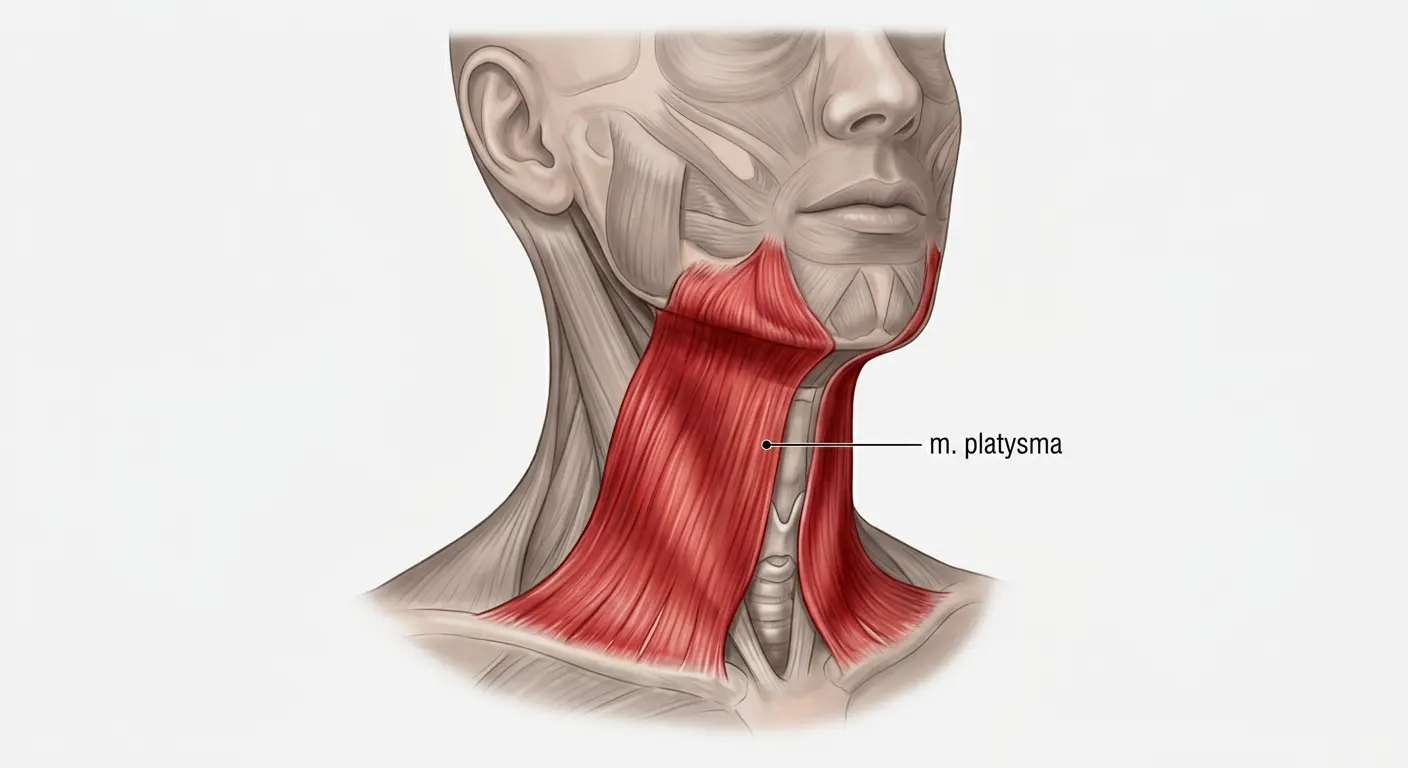
The platysma is a broad, thin sheet of muscle that originates from the fascia over the upper chest, around the collarbone and shoulder region, and runs upward to insert on the lower jaw, the corner of the mouth, and the skin of the lower face.1 It’s a voluntary muscle, meaning it responds to training, but its main documented actions are drawing the corners of the mouth downward and pulling the neck skin upward when the jaw clenches or the mouth opens against resistance.1
That second action is the important one for training it on purpose. Almost every neck exercise, and every neck trainer on the market, works the neck through flexion and extension: nodding the head forward and back. That motion barely engages the platysma at all. Opening the jaw against resistance does, because the muscle’s own attachment to the mandible means jaw-opening is one of the few movements that puts it under a real, controllable load.
How do jawline exercises tone the platysma muscle?
Like any skeletal muscle, the platysma adapts to progressive load: consistent, controlled resistance over weeks builds tone and firmness in the tissue itself, which is what gives the jaw-to-neck line more definition. What it doesn’t do is remove the fat sitting on top of it. A systematic review and meta-analysis of localized resistance training found no meaningful reduction in the fat directly over a trained muscle compared to an untrained one, the same “spot reduction doesn’t work” finding that applies to sit-ups and stomach fat.2 Submental fat responds to the same overall body-composition factors as fat anywhere else, not to how many reps a specific area gets.
That’s a reason to be precise about what platysma exercises are for, not a reason to skip them. A firmer, better-toned platysma changes how the jawline and upper neck look independent of the fat layer, the same way toning the muscle under any other soft area changes its shape without claiming to burn the fat off it.
How does an adjustable neck trainer target the platysma specifically?
The Bejoyland NECKY‘s chin strap sits under the jaw rather than behind the head, so the elastic resistance pulls against the jaw-opening motion itself instead of against neck flexion or extension. That’s a different exercise from what a standard neck harness trains, and it’s the one that actually loads the platysma, per the mechanism described above.
The resistance is adjustable in small increments, which matters here more than almost anywhere else on the body. The platysma is thin and the skin over it is delicate, so the training load needs to start low and build gradually rather than jumping to a fixed resistance the way a heavier muscle group might tolerate.

How do you build a safe platysma workout at home?
Start with the bodyweight version of the movement before adding resistance, so the pattern is familiar before any load is involved.
- Sit upright and open your jaw slowly against no resistance at all, feeling the front of the neck and the underside of the jaw engage rather than the sides of the neck.
- Once that motion feels controlled, put on the trainer with the tension set to its lowest level and repeat the same slow jaw-opening movement against the band.
- Hold briefly at the point of resistance, then return to the closed position with control rather than letting the band snap the jaw shut.
- Work in short sets, a few repetitions at a time, since this is a small, thin muscle that doesn’t need or tolerate heavy volume.
- Increase the resistance in small steps only once a given level feels easy to control, not on a fixed schedule.
Bejoyland NECKY and platysma exercises are built for general fitness and muscle toning, not to diagnose, treat, or cure any medical or cosmetic condition. If you have a pre-existing cervical-spine condition, a jaw joint (TMJ) disorder, or recent facial or neck surgery, talk to a healthcare provider before starting a new resistance routine for this area.
FAQ
Can exercise really tone the platysma muscle?
Yes. The platysma is a voluntary skeletal muscle, and like any other muscle, it responds to progressive resistance with improved tone over consistent training. What it can’t do is remove the fat sitting on top of it, which is a separate, body-composition-driven process.
Why does resistance on jaw-opening matter more than regular neck exercises?
Standard neck exercises move the neck through flexion and extension, nodding forward and back, which barely involves the platysma. The platysma’s own attachment runs to the lower jaw, so opening the jaw against resistance is one of the few controllable movements that actually loads it.
Do jawline exercises actually help with a double chin?
The most effective jawline exercises tone the platysma underneath the chin, which can make the jaw-to-neck line look more defined, but they don’t reduce the fat itself. Research on localized resistance training consistently finds no targeted fat loss from training the muscle underneath a specific area, so exercise addresses the muscle side of the equation, not the fat side.
What's the difference between submental fat and a weak platysma?
Submental fat is adipose tissue sitting under the chin, largely set by genetics and overall body composition. A weak platysma is a muscle-tone issue in the sheet of muscle beneath that fat layer. They often show up together, which is why “double chin” gets blamed on fat alone when muscle tone is frequently part of it too.
Can platysma exercises help with jowls?
The platysma’s upper fibers attach near the corners of the mouth and the lower cheek, so training it can support the muscular structure in that area. Jowls also involve skin laxity and fat repositioning with age, factors a muscle-toning exercise doesn’t address on its own.
Is it safe to train jaw-opening resistance daily?
Short, low-resistance sessions are generally well tolerated, but the platysma is thin and the jaw joint underneath it can be sensitive to overuse. Start with a few short sets, keep resistance low while the pattern feels new, and stop and consult a healthcare provider if you notice jaw discomfort rather than muscle fatigue.
Sources
- Gudmundsson S, Woodson G. Anatomy, Head and Neck, Platysma Muscle. StatPearls, StatPearls Publishing. NCBI Bookshelf.
- Gentil P, et al. A proposed model to test the hypothesis of exercise-induced localized fat reduction (spot reduction), including a systematic review with meta-analysis. Human Movement, 2022.